

Why Katy Perry going to space isn’t exactly a 'Girl Power' win
Lucy Sarret unpacks the recent Blue Origin all-female space flight and its feminist implications
Credit: Blue Origin
Last weekend, Katy Perry strapped herself into a Blue Origin space capsule and rocketed beyond the Kármán line with an all-female crew. It was pitched as historic, inspirational, and yes –empowering. A modern-day Spice Girls moment, but in space.
Except, in reality, the flight felt less like feminist progress and more like a billionaire-funded publicity stunt dressed up in pink-tinted girlboss goggles.
Let’s talk about it.
The basics (and the billionaires)
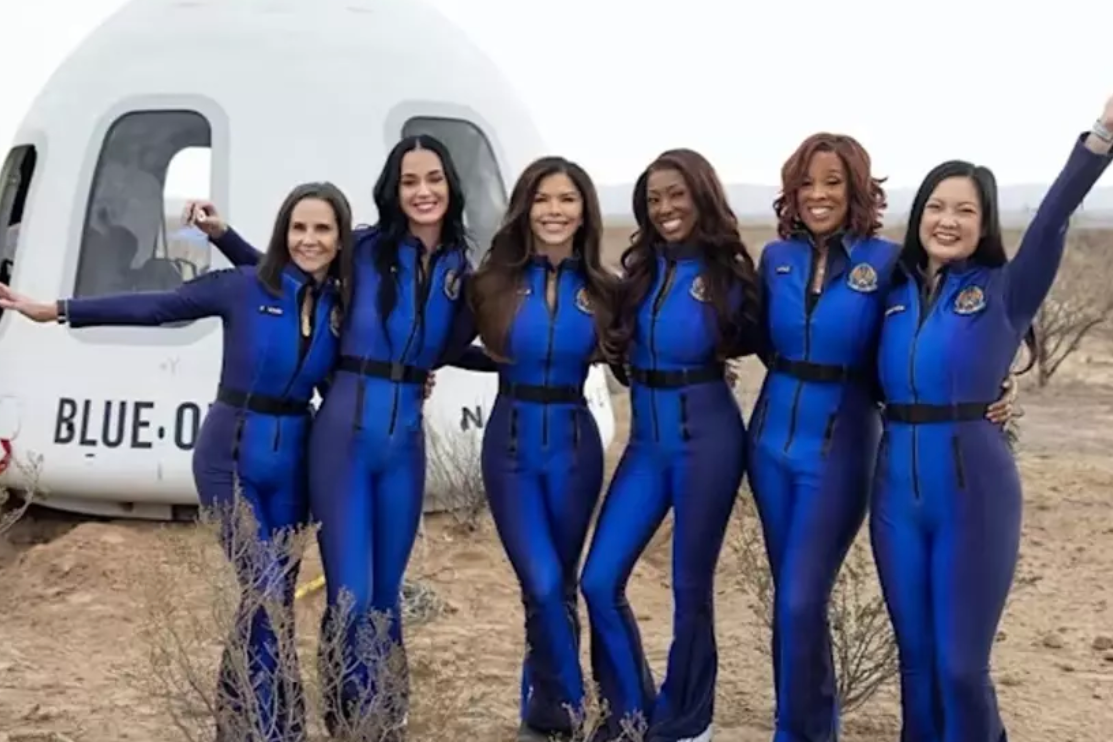
The April 2025 mission, Blue Origin’s NS-31, was marketed as the first all-women crewed spaceflight since 1963. Alongside Perry were journalist Gayle King, philanthropist Lauren Sánchez (also known as Jeff Bezos’ partner), astronaut Amanda Nguyen, NASA engineer Aisha Bowe, and filmmaker Kerianne Flynn.
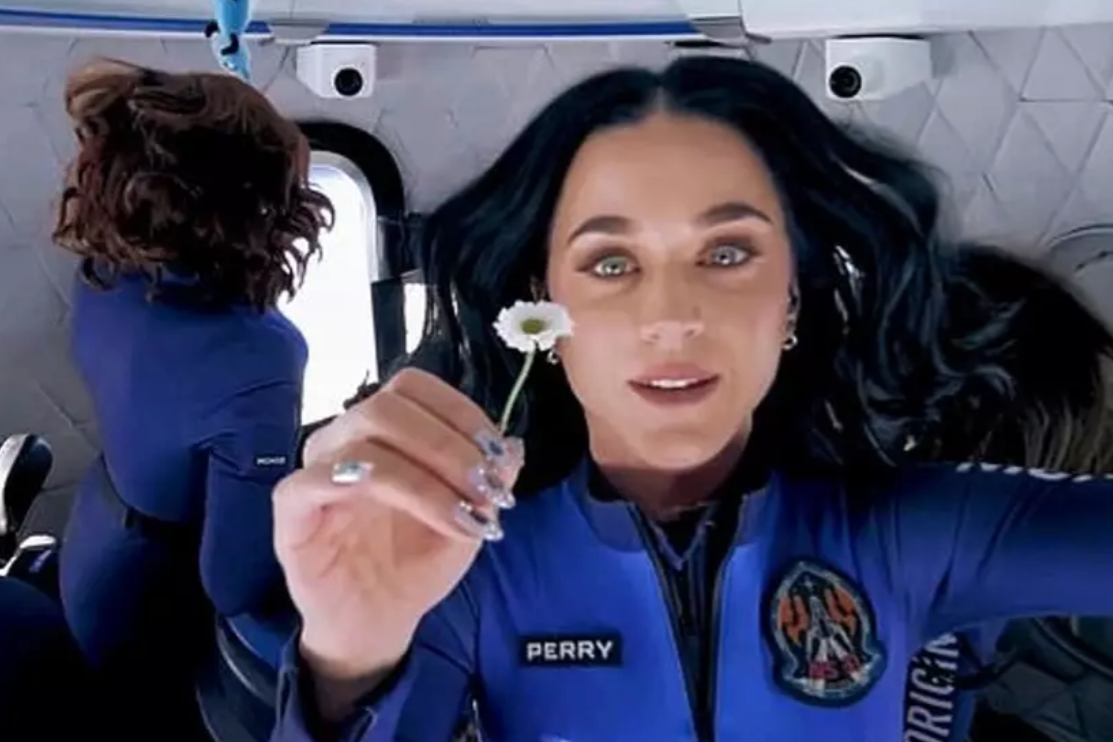
The whole thing lasted eleven minutes – enough time to float a bit, cry a little, and, in Perry’s case, sing “What a Wonderful World” while holding a daisy for her daughter, and revealing the setlist for her upcoming tour.
It was certainly a moment. But who was it really for?
Read more: How Luigi Mangione became an unlikely online phenomenon
Space tourism is not social progress
Blue Origin, the brainchild of Amazon founder Jeff Bezos, is part of a growing billionaire space race.
Yes, the optics of an all-female crew were striking. But this was not a NASA mission or a global scientific milestone. It was a branded jaunt made accessible only to the ultra-rich and ultra-connected.
It's one thing when private companies take rich people into the stratosphere for sport. It’s another when they try to frame it as feminism. There’s a big difference between representation and liberation –and this flight was the former, not the latter.
In other words: this wasn't Sally Ride (an actual astronaut and physicist, who was the first American woman to go to space, and the third woman ever in history to do so) smashing the glass ceiling; it was Katy Perry floating in zero gravity while the rest of us are still trying to afford our rent.
‘Empowerment’ is not just who gets to go to space
When Beyoncé said, “Who run the world? Girls,” she probably didn’t mean the same girls with private jets, a Blue Origin invite, and a billionaire boyfriend.
Social media was quick to point out the irony (and make countless jokes): a luxury trip sold as a feminist win while countless women around the world are fighting actual battles for autonomy, safety, and basic human rights.
Model and actress Emily Ratajkowski didn't mince words, describing the mission as ‘beyond parody’and expressing her disgust over its environmental implications.
“Saying that you care about Mother Earth, and it’s about Mother Earth, and going up in a spaceship that is built and paid for by a company that’s single-handedly destroying the planet?” the model said in a social media rant. “Look at the state of the world, and think about how many resources went into putting these women into space, and for what?”
As one commenter on her Tiktok noted, “They acted like it was a win for feminism. The money used to send them to space could have been used to actually help women in so many ways.”
Actress Olivia Munn also voiced her concerns, labelling the trip as ‘gluttonous’ during an appearance on "Today with Jenna & Friends", in a time where “people can’t afford to buy eggs”.
“Space exploration was to further our knowledge and to help mankind”, she added. “What are they gonna do up there that has made it better for us down here?”
The language of ‘empowerment’ has been co-opted by brand culture for years now. Everything from protein bars to razor adverts has been drenched in pastel slogans about confidence and self-love. But here’s the thing: putting women in a space capsule does not dismantle the structural inequalities that keep so many other women grounded.
Environmental cost? TBD
While Blue Origin boasts that its rockets burn liquid hydrogen and oxygen, producing only water vapour, the emissions involved in rocket manufacturing, fuel production, and logistics still add up.
Drilling into the environmental cost of Perry’s out-of-this-world outing, experts have flagged that even supposedly ‘clean’ rocket fuel isn’t as innocent as it sounds. One atmospheric chemist told the BBC that anything combusted at high temperatures, like rocket fuel, can convert naturally occurring nitrogen in the atmosphere into harmful nitrogen oxide gases, which have a damaging effect on the ozone layer.
For those who skipped that GCSE science lesson, the ozone layer is basically Earth’s SPF; it shields us from the Sun’s harmful radiation and sits high in the stratosphere, where it’s especially vulnerable.
Credit: Blue Origin
And while Blue Origin likes to brag about only emitting water vapour, that’s not the win it sounds like. BBC science correspondent Victoria Gill pointed out that water vapour is itself a greenhouse gas, and critically, it’s not meant to be in the upper layers of the atmosphere. Rockets, she notes, push emissions through multiple atmospheric layers, and those by-products don’t just vanish once the capsule lands – they linger.
Even if the trip itself was cleaner than, say, a Kardashian’s flight to Milan, the real issue is the message: space tourism, even "sustainable’ space tourism, is not exactly in step with the climate-conscious future we supposedly want.
Especially when the rest of us are being told to offset our carbon emissions by eating less meat and turning the lights off at 10 pm.
Read more: Politically erect: How Gen Z navigate relationships in a polarised era
The feminist optics are shaky
The backlash wasn’t just environmental. Perry, whose career has swung from pop princess to left-field mum-fluencer, was mocked online for taking part. Wendy’s, of all brands, even subtweeted her, asking if we can ‘send her back’ to space. Critics called it cringe, out of touch, and an obvious PR move.
To be fair, Perry said the trip was about showing courage to her daughter and modelling female fearlessness. And that’s sweet. But one can’t help but ask: who gets to be fearless? Who gets to be in that position in the first place? And how meaningful is “representation” when it only reflects the 1%?
Inclusion isn’t just about the line-up
While it’s tempting to celebrate a diverse, all-female crew, we have to remember: inclusion isn’t just about who’s pictured on the rocket. It’s about access, equity, and context. A Black woman in space is incredible. A Black woman in space because she’s a billionaire’s guest, while millions of other Black women are denied healthcare, housing, or education? That’s marketing, not revolution.
So, what would real progress look like?
Maybe real feminist space travel would look like public funding going toward STEM education for girls. Or women scientists from underrepresented backgrounds getting access to groundbreaking research opportunities. Maybe it’s not about who gets to go to space, but who gets to dream about it –and who’s actually given the tools to make that dream real.
Until then, we’re not saying Katy shouldn’t have gone. But let’s stop pretending this was some kind of radical act. Sometimes a rocket is just a rocket. And sometimes girlbossing too close to the sun just leaves you looking… out of orbit.